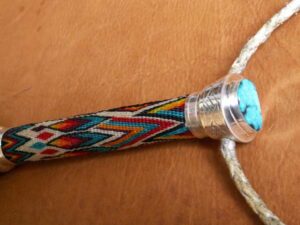
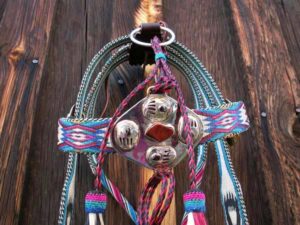
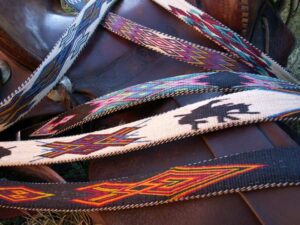
Close-up of Mariposa Lapwai browband
The history of hitched horsehair is, at best, sketchy. Most likely it dates back to the Moors who conquered Spain in the 8
th century. Spaniards brought this art to the New World where it was refined. Cowboys, Indians, Mexicans, sheepherders, and prison inmates have primarily worked horsehair.
(4/29/10: Here's a possible theory of how hitched horsehair evolved. Ron thought of this recently. He's a sailor, even built his own wooden sailboat the past two years, and is a Navy veteran. Could the sailors on the boats which transported the Spanish soldiers to the New World have a connection with hitched horsehair? After all, sailors use the two knots that are used in hitched horsehair. And there was available horse tail hair on the boats. And plenty of time as they crossed the ocean. Just a thought.......)
The history of hitching is intertwined with the history of territorial and modern day prisons in the western United States. It was the first hobby at Montana, dating back to the territorial prison in Deer Lodge. Other prisons known for horsehair were located at Yuma, Arizona; Rawlins, Wyoming; and Walla Walla, Washington. Some experts can date and tell which prison an item was made at because of the colors. At various times commercial dyes were not available and natural colors were only used. Pink was a popular color in old headstalls, with Yuma noted for its bright dyed colors. At Montana State Prison, cotton butcher twine was taken from the slaughter house and used to hitch over.
As inmates came and went from prison, hitching cycled in and out, to the extent of being almost a lost art. Once an inmate discharged (finished all his time), or was paroled, he usually discontinued hitching.
The elaborate barter system inside prison walls included knowledge on how to hitch horsehair. Some inmates have paid the equivalent of up to $1,000 to learn. This price could include the student making 3,000 pulls for the teacher before hitching lessons even began.
Prison hobby programs have changed since the 1800’s territorial prisons. But the purpose has remained the same. Allowing hobby keeps the inmates busy, which creates less pressure and less trouble. Hobby also builds self-esteem, which reduces tension. A 1987 study in California showed that inmates who did hobby more than six months were 51% less likely to return to prison. Other research concluded that inmates participating in art programs showed a 70 to 80% reduction in violent and other disruptive behavior while in prison.
Today, with the increased knowledge on how to hitch horsehair, a prison connection is not necessary in order to learn. Though still obscure, this is no longer a lost art. Contemporary hitchers are expanding both the patterns and products made with hitched horsehair.
It is important to note that hitched horsehair is
not the same as braided horsehair. Hitched horsehair is a series of knots with horse tail hair; braiding is, well, braided. Hitched horsehair will last generations, while braiding does not have the same lasting stability.
Shoni and Ron Maulding use hitched inlays in sterling silver for necklaces, bolos, and buckles. They also put inlays in an Indian cradleboard, quiver, and have told the Flight of the Nez Perce in 1877 story in an award-winning belt.
Shoni & Stetson (yep, the hat company...):
There's a new show in the western world. Women Who Design the West premieres in Cody, Wyoming, September 2010. It's an exclusive exhibition featuring women who design and create western craft. And Shoni has been invited to the show.
Stetson has endorsed Women Who Design the West and will be inducting each craftswoman into the Stetson Craftsman's Alliance. The mission of the alliance is to recognize and honor excellence across western craft disciplines.
Thea
Marx has worked with Stetson for several years on this project. Thea
also directs Style West, held at the same time. Both shows open, free
to the public, at noon on Thursday and Friday, September 23-24, and at
10 a.m. on Saturday, September 25. The event closes daily at 6 p.m.
Website: www.womenwhodesignthewest.wordpress.com.
Upcoming Classes:
We are always open to one-on-one three day workshops, taking up to two
students at a time in our studio at Kettle Falls, Washington. Check the
"Instruction" page of this website for more information.
Montana Academy of Living History to present two sessions on hitched horsehair in Deer Lodge, Montana, September 16-17, 2010.
First
session: Find out what hitched horsehair is, a general description of
how it is done, and display of finished products. This is an overview
discussion. A question and answer period will be at the end of the
session. This is September 16, 1 p.m. to 3 p.m.; fee of $10.00.
The second session
is an accelerated how-to and hands-on for beginners. Students will make
a hitched horsehair key fob, having hands on experience with making
pulls, the two knots used in hitching, and understanding drop, add, and
standing pulls. The six row diamond, the basis for all geometric
patterns will be hitched, but not completed due to time constraints.
Class is limited to ten students. Please bring small scissors and a
ruler. We recommend that people taking the how-to, hands-on session
also attend the two hour overview session on Thursday. This session is
September 17, 8 a.m. to noon.
For more information and to
register: www.academyoflivinghistory.com; or e-mail:
This e-mail address is being protected from spam bots, you need JavaScript enabled to view it
Or
call the Powell County Museum and Arts Foundation, phone number
406-846-3111.
KSPS TV Interview: In October, 2006, we were featured on Northwest Profiles, a program of KSPS PBS TV in Spokane, Washington. This interview can be accessed on their website, www.ksps.org. Click on Local Productions; then on Northwest Profiles; then on Archives; then on the alphabet letters "G-L"; scroll down to "Knotted Up (Hitched Horsehair Hitching)". The interview is also on YouTube - type in hitched horsehair. This is not an instructional video, but does show Shoni hitching, Ron doing silverwork, and shows photos of the old Montana State Prison in Deer Lodge, Montana.
Old Pieces: Appraise, Buy, and Sell: These businesses are experts in providing these services on old pieces. We know them all, have met them all, and do restoration work for all of them. They're listed in alphabetical order.
1. Antiques of the Old West, Elmer and Jan Diederich, P.O. Box 756, Big Timber, MT 59011; 406-932-7787; website: www.elmerdiederich.com; e-mail:
This e-mail address is being protected from spam bots, you need JavaScript enabled to view it
2. Fighting Bear Antiques, Terry and Claudia Winchell, P. O. Box 3790, Jackson, WY 83001; 307-733-2669; e-mail:
This e-mail address is being protected from spam bots, you need JavaScript enabled to view it
Store address is 375 South Cache in Jackson, WY.
3. High Noon, Joseph and Linda Sherwood, 9929 Venice Boulevard, Los Angeles, CA 90034; 310-202-9010; website: www.highnoon.com; e-mail:
This e-mail address is being protected from spam bots, you need JavaScript enabled to view it